
PowerBait is the single most effective bait for hatchery-raised trout. That’s not marketing — it’s just the reality of how stocked fish were raised and what they recognize as food. Stocked rainbow trout spend their whole lives before release eating floating pellet food. PowerBait mimics that food in both buoyancy and scent. The floating rig puts the bait exactly where hatchery fish expect to find it: suspended just off the bottom.
I’ve fished a lot of PowerBait over the years on SoCal lakes — Dixon, Big Bear, Irvine — and it works. My daughter Scarlett caught her first trout on a chartreuse PowerBait glob at Dixon. Is it exciting fishing? Not really. You cast, set the rod in a holder, and wait. On a cold morning it can be a test of patience. But it catches fish consistently and it’s the best technique for introducing kids or first-timers to trout fishing because the action happens fast enough to keep them engaged.
Why PowerBait Works on Stocked Trout
Hatchery trout are conditioned from hatching to eat floating pellets dropped into their raceway tanks. They look for food at mid-water depth, not on the bottom or at the surface. When stocked into a lake or pond, they continue looking for food at that same mid-water depth — which is exactly where a floating PowerBait rig presents it.
Wild trout are a different story. Their diet is insects, crustaceans, and small baitfish, and they ignore PowerBait almost entirely. This is why PowerBait is devastating on Big Bear the day after a stocker truck visits, and completely useless on the Poudre River two hours east of Denver.
The Basic PowerBait Rig
This is a sliding sinker rig (sometimes called a Carolina rig). The sinker stays on the bottom; the bait floats up from it at leader length. Exactly where the fish are looking.
- Thread the main line through a small egg sinker (1/4–1/2 oz)
- Tie a small barrel swivel to stop the sinker from sliding to the bait
- Attach 12–18 inches of 4–6 lb fluorocarbon leader to the swivel
- Tie a size 12–14 bait hook to the leader
- Pinch a marble-sized ball of PowerBait around the hook — cover the hook completely
- Cast to open water and let it settle — sinker rests on bottom, PowerBait floats above it at leader length
Open the bail and leave the line slack so fish can take without feeling resistance. When the line starts moving or the rod tip bends with clear pressure, close the bail and set the hook.
PowerBait Colors
Chartreuse and rainbow are the top-producing colors nationally. Chartreuse works especially well in stained water or low light. Rainbow (pink/orange/yellow blend) works well in clear water and on fresh stockers. Carry both.
For finicky fish or after the easy bite has slowed down, try:
- Orange — often triggers follow-up strikes after the initial chartreuse bite dies off
- Yellow — good in clear water with bright sun
- White/glitter — underrated color, especially in cold water
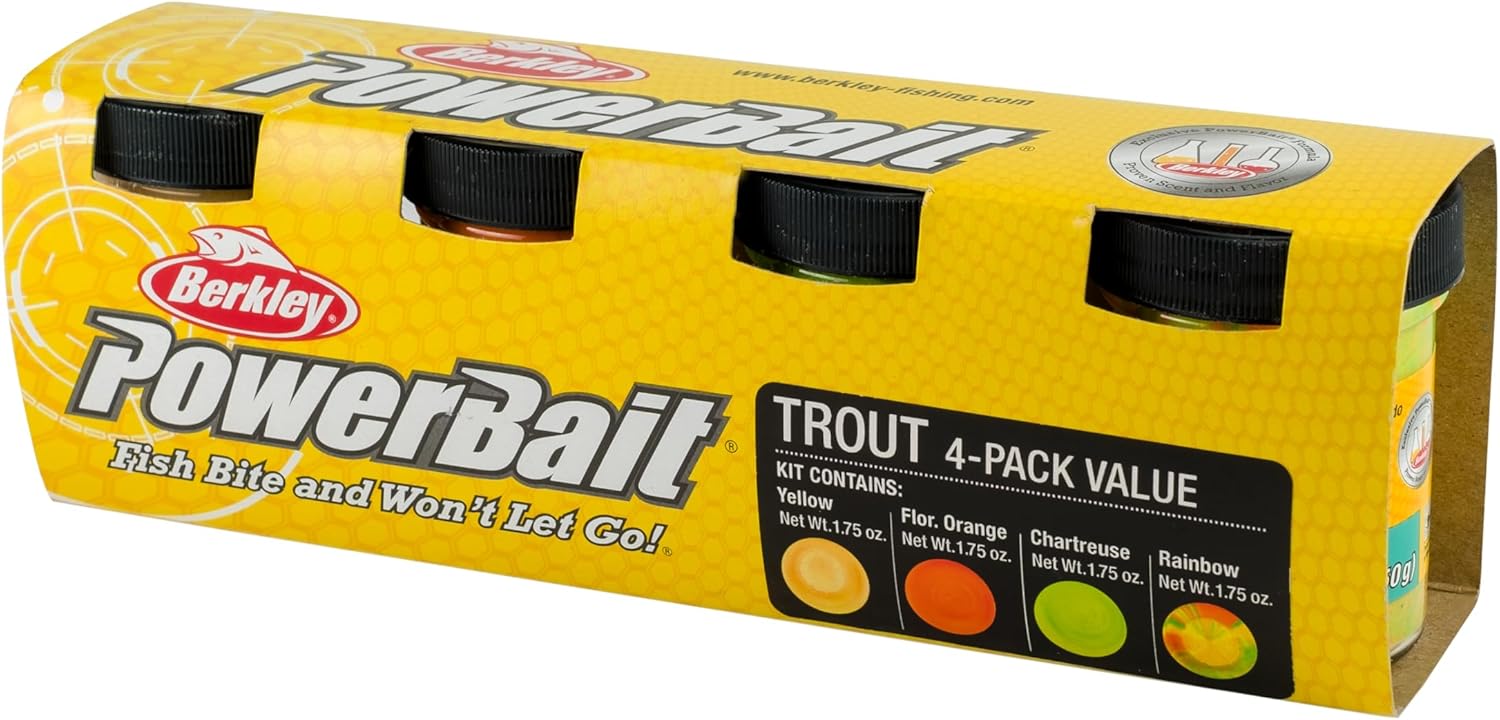
➜ Berkley PowerBait 4 Pack — Buy on Amazon
➜ Berkley PowerBait Single Jars — Buy on Amazon
Terminal Tackle
Hooks: Size 10–14 bait hooks or egg hooks — completely hidden by the PowerBait. Smaller hooks hide better; larger hooks hold better. Size 12 is the best compromise for most conditions.
➜ Gamakatsu Baitholder Hooks Size 10 — Buy on Amazon
Egg sinkers: Start with 1/4 oz for most situations. Use 1/2 oz if you need to cast farther or fish deeper water.
➜ Egg Sinker Assortment — Buy on Amazon
Fluorocarbon leader: Less visible than mono in clear water. On stocked lakes where fish aren’t leader-shy, 4 lb mono is fine. On clearer water with pressured fish, fluorocarbon is worth the upgrade.
➜ Seaguar Gold Label 6lb Fluorocarbon — Buy on Amazon
Where to Cast
Stocked trout hold near the stocking point for days after release, gradually dispersing as they get comfortable. If you can find out where the stocking truck released fish — ask at the bait shop, check the lake’s visitor info, or look for anglers catching fish — that’s your starting point.
Other productive spots:
- Near inlet streams — cooler water where fresh oxygenated water enters the lake
- Along gradual drop-offs — where shallow flats meet deeper water
- Near shoreline structure — fallen trees, dock pilings, rock piles
- Wind-blown shorelines — wind pushes surface food toward downwind shores; fish follow
If one spot hasn’t produced in 30–45 minutes, move. Stocked trout cluster — where you find one, there are usually more. A slow spot rarely improves; a slow day often just means you haven’t found the cluster yet.
Alternative Baits for Stocked Trout
PowerBait is the default but not the only option. A few alternatives worth carrying:
Salmon eggs: Work especially well for freshly-stocked fish that haven’t figured out PowerBait yet. Also excellent for wild trout in the right situations.
➜ Berkley Gulp Salmon Eggs — Buy on Amazon
Nightcrawlers: Thread on a size 8–10 hook leaving the tails to wiggle. Works on both stocked and wild trout. A classic bait that’s been catching trout for generations.
➜ Berkley Gulp Nightcrawler — Buy on Amazon
Fishing With Kids
This is where PowerBait really shines. Kids need action to stay interested, and PowerBait on a stocked lake delivers more action than any other method for young anglers. A few tips from taking Scarlett fishing:
- Rig the rod yourself — little hands struggle with knots and baiting hooks
- Keep gear simple — one rod, one rig, one jar of PowerBait
- Bring snacks and drinks — fishing is the backdrop; the outing is the event
- Let them reel in every fish, even small ones — the reeling is half the fun
- Watch your rod tips together — turns waiting into shared anticipation
A kid who catches one trout on their first trip will want to come back. A kid who sits for four hours with no bites usually won’t. Choose a productive lake, fish in the morning, and start with what works.
Frequently Asked Questions
Does PowerBait work on wild trout?
Rarely. Wild trout feed on insects and invertebrates, not pellet food. For wild trout in streams and rivers, flies, spinners, and natural bait are far more effective. PowerBait is specifically a stocked-trout tool.
How long should my PowerBait leader be?
12–24 inches. Longer leaders let the bait float higher off the bottom — useful when fish are suspended. Start with 18 inches and adjust based on what’s working. If you’re not getting bites, try shortening or lengthening before changing anything else.
What’s the best time of day for PowerBait fishing?
Early morning (first light to 9 AM) and late afternoon (4 PM to dusk) are most productive. Midday can be slow, especially in summer when water warms.
Do I need to reel in every few minutes?
No — let the rig sit. Stocked trout usually take the bait while it’s stationary. Reel in only to check the bait every 20–30 minutes or when you think it’s been bumped.
Can I use PowerBait in rivers?
It’s less effective in rivers because the current makes the floating rig behave unnaturally. Stick to lakes and ponds for PowerBait. In rivers, small spinners or natural bait drifts work better.
Related Guides
About the Author
By Kenny — SoCal angler who learned trout fishing during college years in Fort Collins, Colorado (Poudre, Horsetooth, Estes Park) and now fishes the Sierras and SoCal lakes with my daughter Scarlett. No steelhead or salmon yet, and no ice fishing — those are on the list.
Affiliate Disclosure: As an Amazon Associate, troutfishing-hq.com earns from qualifying purchases. Links to Amazon on this page are affiliate links — if you click and buy, we may earn a small commission at no extra cost to you.